









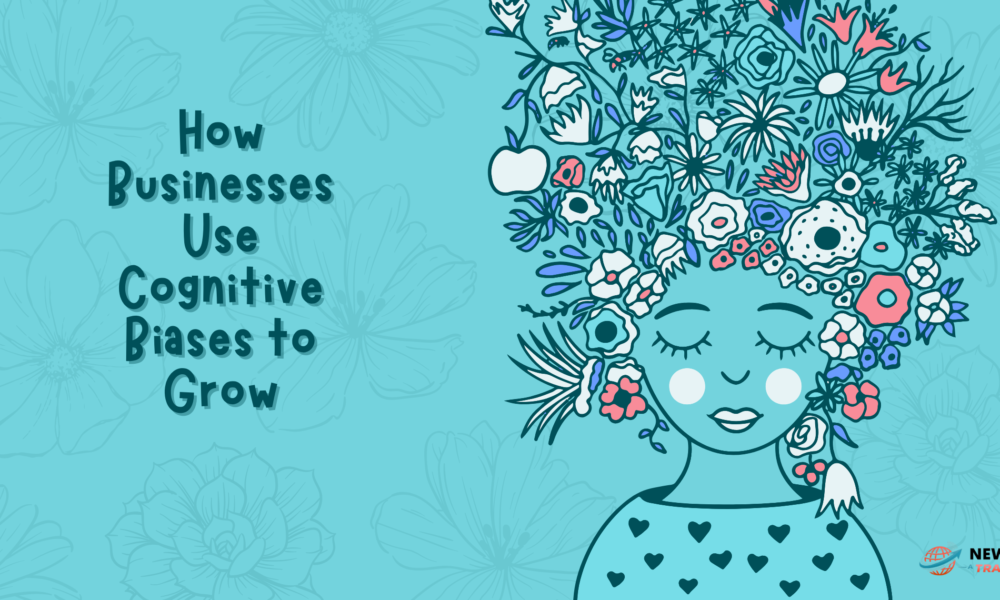
How Businesses Use Cognitive Biases to Grow?
Think about the last time you bought something online. Did you read reviews first? Did a countdown timer make you checkout faster? Did seeing a high original price next to a discounted one make the...

Think about the last time you bought something online.
Table Of Content
- What Are Cognitive Biases?
- The Role of Cognitive Biases in Consumer Behavior
- 4 Powerful Cognitive Biases in Business
- 1. The Anchoring Effect
- 2. The Scarcity Principle
- 3. Social Proof
- 4. Loss Aversion
- More Biases to Consider
- The Decoy Effect
- The Halo Effect
- Confirmation Bias
- Applying Biases Across Business Functions
- Marketing Strategy
- Sales Tactics
- Customer Engagement
- Navigating the Ethics of Behavioral Economics
- Actionable Steps to Implement Cognitive Biases
- Summary
Did you read reviews first?
Did a countdown timer make you checkout faster?
Did seeing a high original price next to a discounted one make the deal feel too good to pass up?
If you answered yes to any of these, a business just successfully leveraged your cognitive biases.
Human beings like to think we make completely rational choices. We weigh the pros and cons, assess our budgets, and make logical decisions. However, behavioral economics tells a completely different story. Our brains process millions of pieces of information every second. To keep up, our minds create shortcuts. These mental shortcuts, known as cognitive biases, heavily influence how we perceive value and make purchasing decisions.
For businesses, understanding these psychological triggers unlocks a completely new level of growth. When you know how your customers think, you can design marketing campaigns, sales strategies, and customer experiences that align perfectly with human nature.
This guide explores the fascinating world of cognitive biases in business. We will break down exactly how they influence consumer behavior, examine specific biases you can leverage, and discuss how to apply these psychological principles ethically and effectively.
What Are Cognitive Biases?
A cognitive bias is a systematic error in thinking. It happens when people process and interpret information in the world around them. These biases result from our brain’s attempt to simplify information processing.
Life requires constant decision-making. If we meticulously analyzed every single choice—from what coffee to buy to which software to subscribe to—we would experience severe decision fatigue. To prevent this, the human brain relies on heuristics. Heuristics are mental shortcuts that help us make rapid decisions.
While these shortcuts are incredibly efficient, they are not always perfectly accurate. They cause us to draw conclusions based on feelings, past experiences, and environmental cues rather than objective facts.
In a business context, cognitive biases are not flaws to exploit. They are fundamental elements of human psychology. When business owners and marketers understand them, they can present information in a way that feels natural, intuitive, and highly persuasive to the buyer.
The Role of Cognitive Biases in Consumer Behavior
Consumer behavior is rarely a straight line. The traditional economic model assumes that consumers are rational actors who always seek to maximize utility. Modern behavioral economics shatters this assumption.
People buy based on emotion and justify with logic. Cognitive biases form the bridge between that initial emotional impulse and the final logical justification.
When a consumer encounters your brand, they immediately look for context clues. They want to know if they can trust you, if your product is worth the price, and if other people like them use your service. Cognitive biases help them answer these questions quickly.
If you present your product without understanding these psychological filters, you leave revenue on the table. You might have the best product in the market, but if you fail to frame your pricing correctly, consumers will perceive it as too expensive. If you lack social proof, they will perceive it as risky.
Aligning your business strategy with cognitive biases reduces friction. It makes saying “yes” to your product feel like the safest, smartest, and most obvious choice.
4 Powerful Cognitive Biases in Business
Hundreds of cognitive biases exist, but a select few dominate the business landscape. Let us explore four of the most impactful biases, how they work, and how you can implement them.
1. The Anchoring Effect
The anchoring effect occurs when people rely too heavily on the first piece of information they receive when making decisions. That initial piece of information becomes the “anchor.” All subsequent judgments are made in relation to that anchor.
If you walk into a boutique and see a $1,000 watch, your brain sets an anchor. If the salesperson then shows you a $300 watch, it suddenly feels like a bargain. If you had seen the $300 watch first, you might have thought it was expensive. The inherent value of the watch did not change, but your perception of its value did.
How Businesses Use Anchoring:
- Discount Pricing: Showing the “original price” crossed out next to the “sale price” is classic anchoring. The higher original price establishes the value, making the sale price feel like an incredible deal.
- Tiered Pricing: Software companies often use this strategy. They present a high-priced “Enterprise” tier first. Even if most users do not need it, seeing a $500/month plan makes the $50/month “Pro” plan look highly reasonable.
- Negotiation: In B2B sales, the party who makes the first offer often dictates the outcome of the negotiation. A high initial proposal sets the anchor, ensuring that even after concessions, the final price remains favorable.
2. The Scarcity Principle
The scarcity principle states that people assign higher value to objects that are rare and lower value to those available in abundance. The fear of missing out (FOMO) is a powerful motivator. When a resource appears limited, we feel an urgent need to acquire it before someone else does.
This bias ties back to evolutionary survival. When food or resources were scarce, humans who acted quickly survived. Today, that same instinct triggers when we see a limited-edition sneaker or a flight with only two seats left.
How Businesses Use Scarcity:
- Limited-Time Offers: Flash sales, holiday promotions, and countdown timers create urgency. Customers know they must act before the clock runs out.
- Limited-Quantity Announcements: Showing stock levels (e.g., “Only 3 items left in stock!”) pushes hesitant buyers to complete their purchase immediately.
- Exclusive Access: Invitation-only apps or VIP membership tiers rely on scarcity. People want what they cannot easily have. Making your product exclusive instantly elevates its perceived value.
3. Social Proof
Social proof is the psychological phenomenon where people copy the actions of others in an attempt to undertake behavior in a given situation. When we are unsure what to do, we look at what others are doing. We assume that if many people are doing something, it must be the correct action.
Imagine walking down a street looking for a restaurant. You see one place completely empty and another with a line out the door. You will likely assume the busy restaurant has better food, even if you have never eaten at either.
How Businesses Use Social Proof:
- Reviews and Ratings: Displaying customer reviews is essential. Consumers trust online reviews almost as much as personal recommendations.
- Testimonials and Case Studies: B2B businesses use case studies to show potential clients that similar companies have achieved success using their product.
- User Metrics: Highlighting the number of users (“Join 50,000+ satisfied customers”) provides immediate validation. It tells the prospect, “You are not taking a risk; thousands of people have already vetted us.”
- Influencer Endorsements: Seeing a trusted figure use a product borrows the influencer’s credibility and transfers it to the brand.
4. Loss Aversion
Loss aversion refers to people’s tendency to prefer avoiding losses over acquiring equivalent gains. Psychologically, the pain of losing $100 is about twice as intense as the joy of finding $100.
Because we hate losing things, we make decisions specifically to protect what we already have. Businesses can frame their offers to highlight what the customer stands to lose if they do not act, rather than just what they will gain.
How Businesses Use Loss Aversion:
- Free Trials: Once a customer uses a product for 30 days, they begin to feel ownership over it. When the trial ends, canceling feels like losing a valuable tool, prompting them to subscribe.
- Money-Back Guarantees: Guarantees remove the fear of financial loss. If the customer knows they can get their money back, the perceived risk drops to zero.
- Abandoned Cart Emails: E-commerce stores remind shoppers what they are leaving behind. Messaging like, “Don’t lose your items! Complete your purchase before your cart expires,” taps directly into loss aversion.
More Biases to Consider
While anchoring, scarcity, social proof, and loss aversion form the foundation of behavioral marketing, several other biases play crucial roles.
The Decoy Effect
The decoy effect occurs when consumers change their preference between two options when presented with a third, asymmetrically dominated option (the decoy).
For example, a movie theater sells a small popcorn for $4 and a large for $8. Many will buy the small to save money. But if the theater adds a medium popcorn for $7.50 (the decoy), the large suddenly looks like a fantastic deal. Customers think, “For just 50 cents more, I get the large!” The medium exists solely to drive sales of the large.
The Halo Effect
The halo effect is a cognitive bias where our overall impression of a person or brand influences how we feel and think about their character or products.
If consumers love a company’s flagship product, they will automatically assume its new products are also excellent. Apple is a prime example. The massive success and sleek design of the iPhone created a halo effect that made consumers readily accept the iPad, Apple Watch, and AirPods as premium, high-quality products.
Confirmation Bias
Confirmation bias is the tendency to search for, interpret, favor, and recall information in a way that confirms one’s preexisting beliefs.
Marketers use confirmation bias by deeply understanding their target audience’s core beliefs and aligning their brand messaging with those values. If a consumer already believes that plant-based diets are superior for the environment, a vegan food brand just needs to validate that belief. The consumer will naturally favor the brand’s marketing because it confirms what they already hold to be true.
Applying Biases Across Business Functions
Cognitive biases are not just marketing tricks. You can weave them into every facet of your business operations to create a seamless, persuasive customer journey.
Marketing Strategy
Marketing is entirely about perception. Use cognitive biases to shape how potential customers view your brand before they even speak to a salesperson.
- Leverage the Halo Effect by ensuring your website design is impeccable. A beautiful, fast website makes visitors assume your product is equally high-quality.
- Use Confirmation Bias in your ad copy. Call out your target audience’s pain points and validate their frustrations.
- Implement Social Proof in all top-of-funnel campaigns. Use user-generated content in social media ads to show real people enjoying your product.
Sales Tactics
Sales teams face the challenge of overcoming objections and closing deals. Cognitive biases provide powerful tools to guide prospects toward a “yes.”
- Use Anchoring when discussing budgets. Start by highlighting the massive cost of the problem they are currently facing, making your solution’s price seem trivial by comparison.
- Introduce the Decoy Effect in your proposals. Offer three packages, structuring the middle package as a decoy to make the premium package look like the best value.
- Utilize Loss Aversion during the closing stage. Remind the prospect of the time, money, or efficiency they lose every day they delay making a decision.
Customer Engagement
Retaining customers is just as important as acquiring new ones. Biases can help build loyalty and encourage repeat purchases.
- Use Loss Aversion in loyalty programs. Show customers the points they will lose if they do not make a purchase by a certain date.
- Leverage Social Proof for upselling. Tell current customers, “People who bought X also bought Y.”
- Create Scarcity with exclusive customer-only events or early access to new product lines. This rewards loyalty while driving immediate action.
Navigating the Ethics of Behavioral Economics
Understanding human psychology comes with significant responsibility. The line between persuasive marketing and manipulative coercion can sometimes blur. When businesses cross that line, they employ what designers call “dark patterns.”
Dark patterns are user interfaces or marketing tactics designed to trick users into doing things they might not want to do, like signing up for recurring bills or sharing excessive personal data.
For example, using a fake countdown timer that resets every time the user refreshes the page is not leveraging scarcity; it is lying. Making it extremely difficult to cancel a subscription is an unethical application of loss aversion.
Ethical use of cognitive biases relies on a simple principle: Nudging vs. Tricking.
A nudge helps a consumer make a decision that ultimately benefits them. It reduces friction and highlights genuine value. Tricking forces a consumer into a decision that only benefits the business, often leaving the customer feeling cheated.
To ensure you use cognitive biases ethically:
- Always tell the truth: If you say you only have five items left, you must actually only have five items left.
- Maintain transparency: Do not hide fees to create a false price anchor. Be upfront about total costs.
- Provide easy exits: If you use a free trial (loss aversion), make the cancellation process simple and clear.
- Prioritize the customer’s best interest: Use psychology to guide them toward a product that actually solves their problem.
When you use cognitive biases ethically, you build trust. Consumers appreciate a smooth, intuitive buying process. When you use them unethically, you might secure a quick sale, but you will destroy your brand reputation and eliminate any chance of customer retention.
Actionable Steps to Implement Cognitive Biases
Reading about psychology is one thing; applying it to your business is another. Here is a step-by-step approach to start leveraging cognitive biases today.
Step 1: Audit Your Current Customer Journey
Map out every touchpoint a customer has with your business. Look at your ads, landing pages, pricing page, and checkout process. Identify where prospects are dropping off. Are they hesitating at the price? Are they abandoning their carts?
Step 2: Choose One Bias to Test
Do not try to implement every bias at once. Pick one area of friction and apply a relevant bias. If people balk at your pricing, test a tiered pricing model to introduce the anchoring effect. If your landing page has a low conversion rate, add prominent social proof near the call-to-action button.
Step 3: A/B Test Your Changes
Never rely on guesswork. Run A/B tests to measure the impact of the psychological trigger. Create two versions of your page—one with the bias applied and one without. Track the conversion rates to see if the bias genuinely influenced behavior.
Step 4: Refine Your Language
Review your copywriting through the lens of loss aversion. Are you only talking about features and benefits? Try rewriting a few headlines to focus on what the customer stands to lose by sticking with the status quo.
Step 5: Gather and Showcase Social Proof
Make collecting reviews and testimonials a standard operating procedure. Automate email requests for reviews after a successful purchase. Once you have this social proof, distribute it across your marketing channels.
Read More: How to Make Money in the Heating and Air Conditioning Business
Summary
Human brains rely on shortcuts to navigate a complex world. Cognitive biases are not irrational quirks; they are predictable patterns of human behavior.
By understanding how anchoring shapes price perception, how scarcity drives urgency, how social proof builds trust, and how loss aversion motivates action, you can fundamentally transform your business operations.
Remember that the goal is never to manipulate. The goal is to present your value in a way that aligns with how your customers naturally think and feel. When you use behavioral economics responsibly, you remove friction from the buying process. You help your customers make confident decisions, and in return, you build a more profitable, sustainable business.
Take a look at your pricing page today. Does it anchor the user properly? Does it offer social proof? Implement just one psychological tweak this week, and watch how human nature responds.









No Comment! Be the first one.